
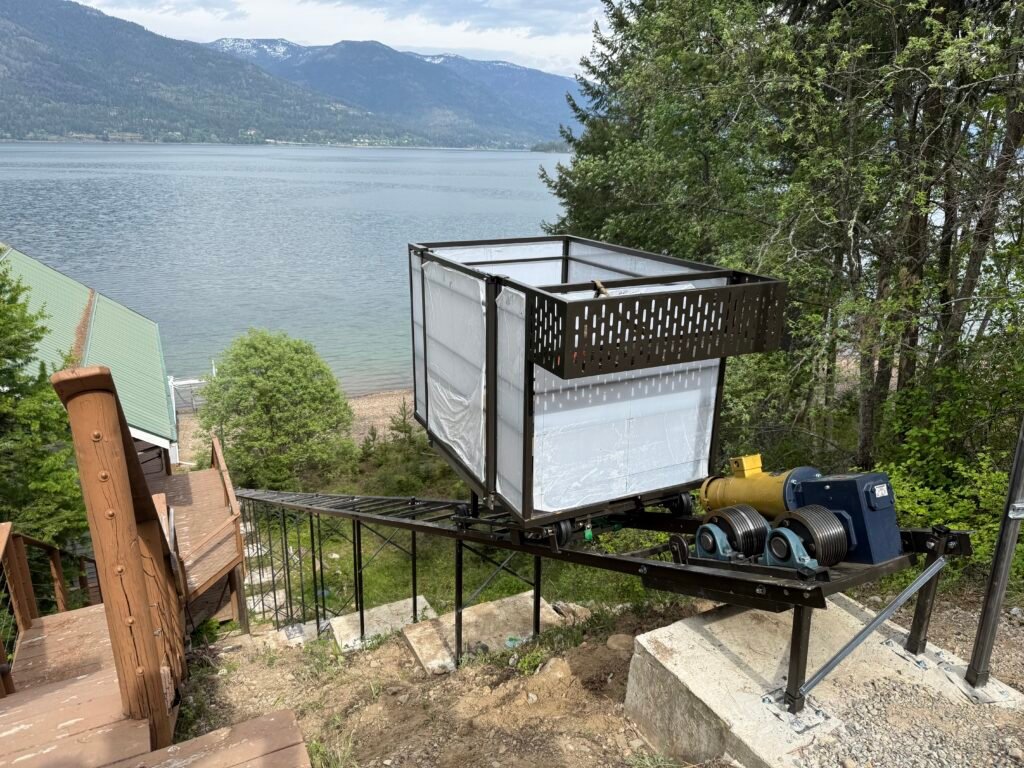
The thing nobody tells you when you buy a lake house on a steep lot is how quickly the stairs stop being charming. The first summer, the climb is part of the experience. By the third summer, you are calculating whether you really need that second trip down for the cooler, and the answer is increasingly no.
That is the problem a hillside tram solves. Not luxury — usage. A waterfront property where the beach is a 90-step climb gets used a handful of times a season. The same property with a tram gets used every single day, by everyone, including the people in your family who quietly stopped going down years ago.
Here is what installing one at a lake house actually involves, drawn from a lakefront install our crew completed this summer.
Why Lake Houses Are a Different Problem Than Hillside Homes
We install trams on all kinds of slopes around Puget Sound, but lakefront lots have their own personality, and it changes the engineering.
The bank is usually the steepest part
Lake lots tend to be gentle near the house and then drop hard in the last stretch before the water. That transition is the hard part. A track has to be engineered across a grade change, which usually means taller towers at the bottom and a drive sized for the steepest section rather than the average.
The soil is often fill
Waterfront property has usually been graded, terraced, and built up by previous owners — sometimes decades ago, sometimes without permits. What looks like solid ground is frequently old fill sitting on native soil. That is not a dealbreaker, but it means engineered footings and, on a high bank, a geotechnical report before anything gets built.
Access is worse than you think
Almost every lake house has one narrow route in. On the install pictured here we could get a tractor partway down the slope, which kept the schedule and the labor cost reasonable. On lots where the only path is a side yard, every beam and every bag of concrete is carried by hand, and that shows up in the quote.
Water and weather are constant
An outdoor machine 40 feet from a lake lives in humidity year round. Components need to be specified for outdoor duty from the start — sealed drives, galvanized or powder-coated steel, drainage designed into the footings. This is not the place for a system adapted from an indoor product.
The short version: a lake house tram is a foundation and drainage project as much as it is an equipment purchase. The car is the easy part.
What It Looks Like Going In
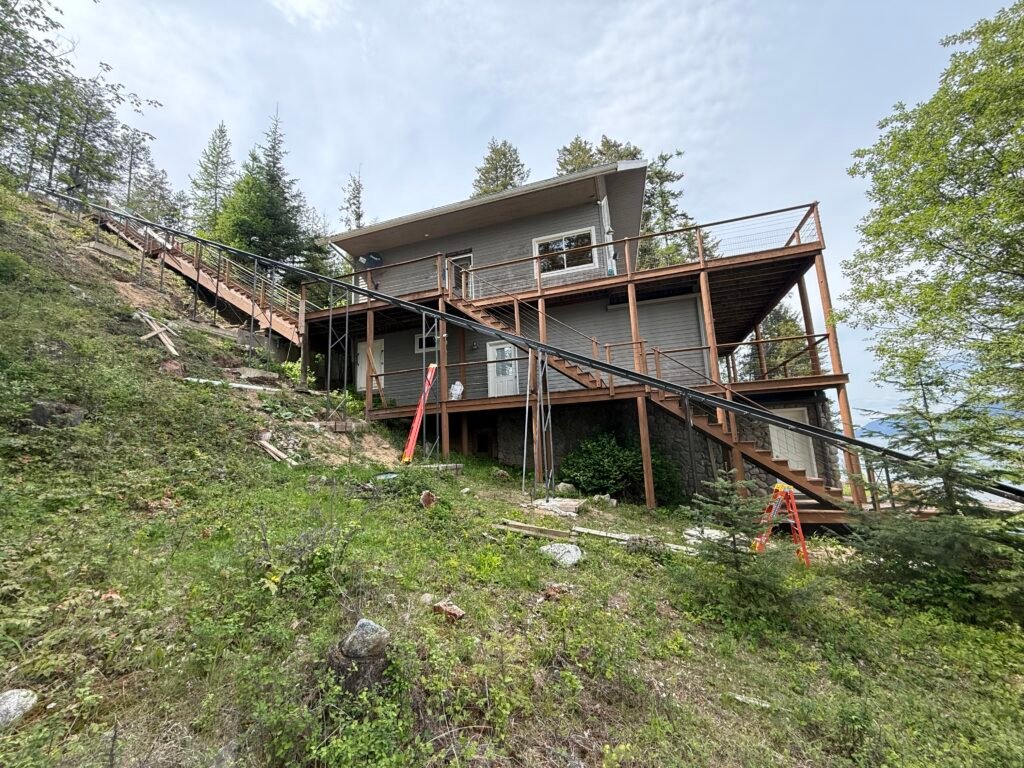
The build follows a fairly consistent order:
- Survey and engineering. We measure the actual slope profile, not an estimate, and lay out where each tower lands. On a lake lot this usually happens alongside a soils review.
- Permitting. Waterfront work frequently touches shoreline rules on top of the standard building permit, so this stage takes longer near a lake than it does on an inland hillside. It is the single most common source of schedule slip.
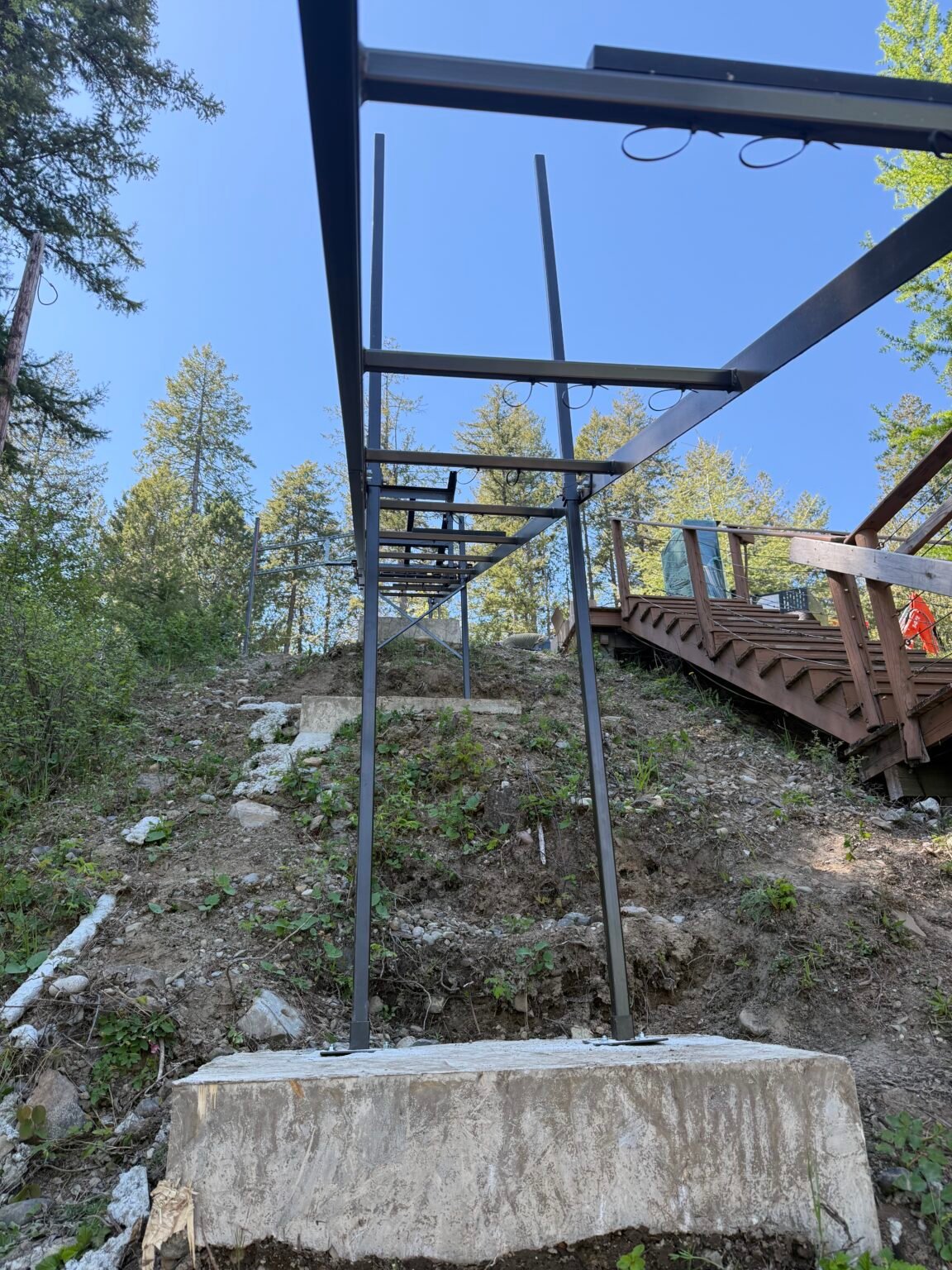
- Footings. Concrete piers go in at each tower location down the run. This is the part that determines whether the track stays true in ten years.
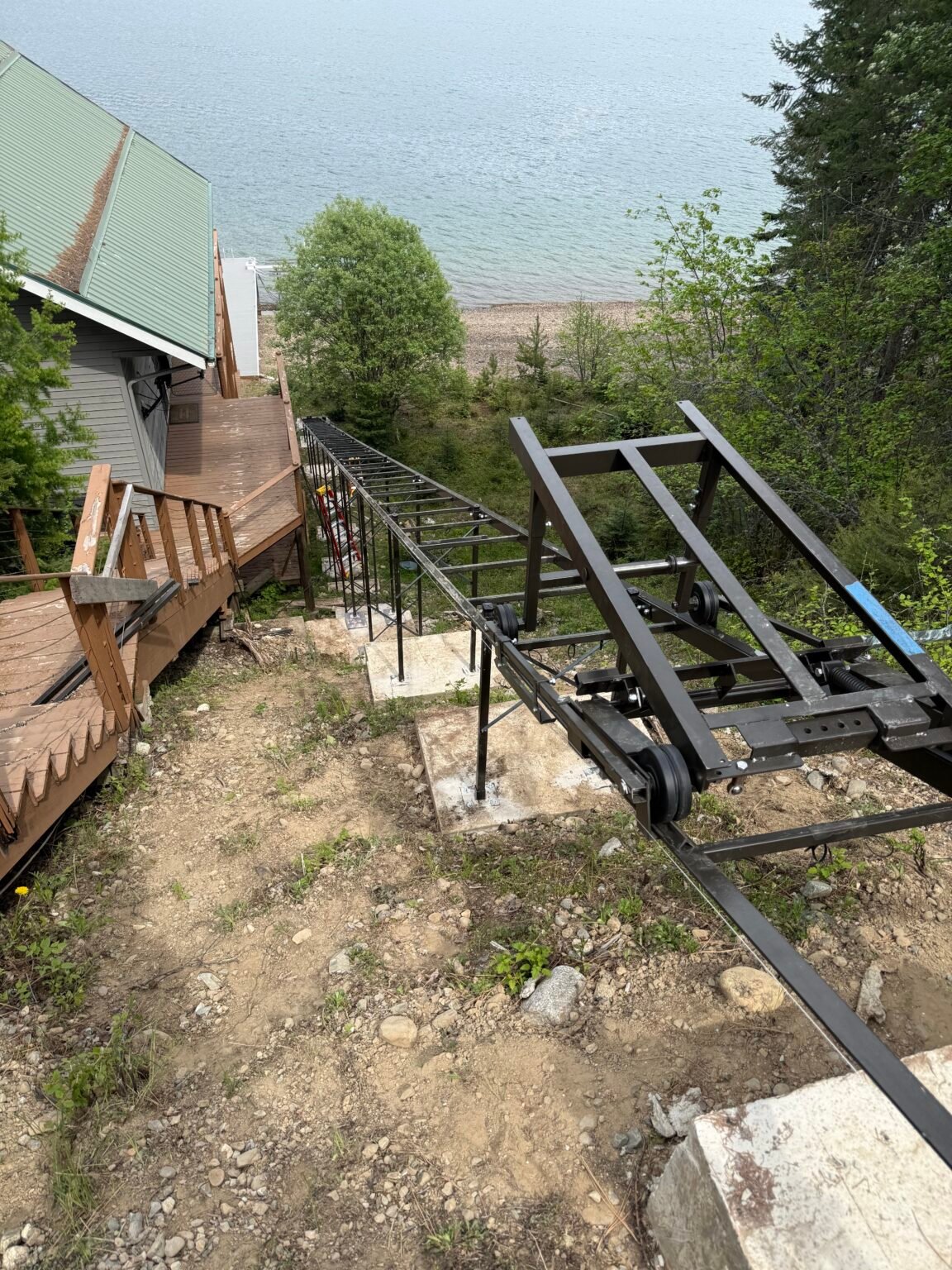
- Towers and track. Steel goes up from the footings, then the track sections are set and aligned. Alignment is fussy, slow work and worth every hour.
- Drive, car, and controls. The drive unit and car go on last, followed by safety systems and battery backup.
- Inspection and commissioning. Load testing, safety verification, and a walkthrough on how to operate and what to watch for.
Design Decisions Worth Getting Right
Size the car for the cooler, not the person
The most common regret we hear is a car that is too small. People picture themselves riding down, so they spec a two-person car — then in practice they are hauling groceries, a cooler, beach chairs, a dog, and a grandchild. A larger car costs more upfront, and unlike most things, it is not something you can change later without replacing the drive.
Decide where the bottom landing goes early
There is a real difference between stopping at the top of the bank and carrying the track all the way to a dock or beach level. The lower landing is more expensive — more track, more foundation, more exposure to water — but stopping short means you have reintroduced the stairs at the exact point you were trying to eliminate them. Think about where you actually want to step off.
Consider a mid-slope stop
If you have a guest cabin, a garden terrace, or a firepit partway down, an intermediate landing is worth pricing. It is a meaningful add, but retrofitting one later is far more disruptive than including it in the original run.
Do not skip the canopy conversation
An open car is standard and holds up fine in Northwest weather. But a lake house gets used in shoulder season too, and arriving at the top dry in November changes how often the thing gets used in the months when carrying things up a wet slope is genuinely unpleasant.
What It Costs
For a lakefront property, most installs land somewhere between $120,000 and $300,000, driven mostly by the length of the run and what the soil turns out to be. The lower end is a shorter run on stable ground with good equipment access. The upper end is a long run down an unstable high bank where everything has to be carried in by hand.
Rather than guess, run your own numbers — we built a hillside trolley cost calculator that asks six questions about your slope and returns a real range. For the full cost breakdown, see how much a hillside tram costs in Seattle.
Thinking about a tram at your lake place?
We will walk your slope, talk through where the landings should go, and put a real number in writing. No charge for the visit.
Schedule a site visitFrequently Asked Questions
Can a hillside tram go all the way down to a dock?
Usually yes. Carrying the track to beach or dock level is common on lake properties and it is generally the right decision — stopping at the top of the bank leaves the steepest stairs in place. It does add cost, because the lower section involves more foundation work and more exposure to water, and shoreline permitting may apply.
Will a tram work on a lot that has had slope movement?
Often, but it changes the engineering. Signs of movement — a leaning retaining wall, a fence out of plumb, water surfacing partway down the bank — mean a geotechnical report and engineered piers rather than standard footings. In some cases stabilizing the slope has to happen first. This is worth surfacing at the first site visit rather than discovering during permitting.
How much maintenance does a lakefront tram need?
Plan on service twice a year and a budget of roughly $600 to $1,500 annually. A tram near water works harder than an inland one — humidity, pollen, and falling debris all accumulate. The maintenance itself is straightforward: cable inspection, track alignment, drive service, and safety system checks.
Does a tram need power run down the hillside?
No. The drive unit sits at the top of the run, so power is only needed at the upper landing. If there is already service at your upper deck this is simple; if the panel is on the far side of the house, budget for a trench and conduit run.
What happens in a power outage?
Systems we install include battery backup, so a car in motion completes its trip and you retain limited use during an outage. This is standard equipment on our installs, not an upgrade — on a waterfront lot where the alternative is climbing the bank in the dark, it is not optional.
Is a tram better than an outdoor stairlift for a lake house?
For most waterfront lots, yes. A tram carries multiple people plus cargo and handles long runs and grade changes. An outdoor stairlift is a lighter, less expensive option best suited to shorter, more uniform runs with an existing stairway. We compared them in detail in hillside tram vs. outdoor stairlift.