
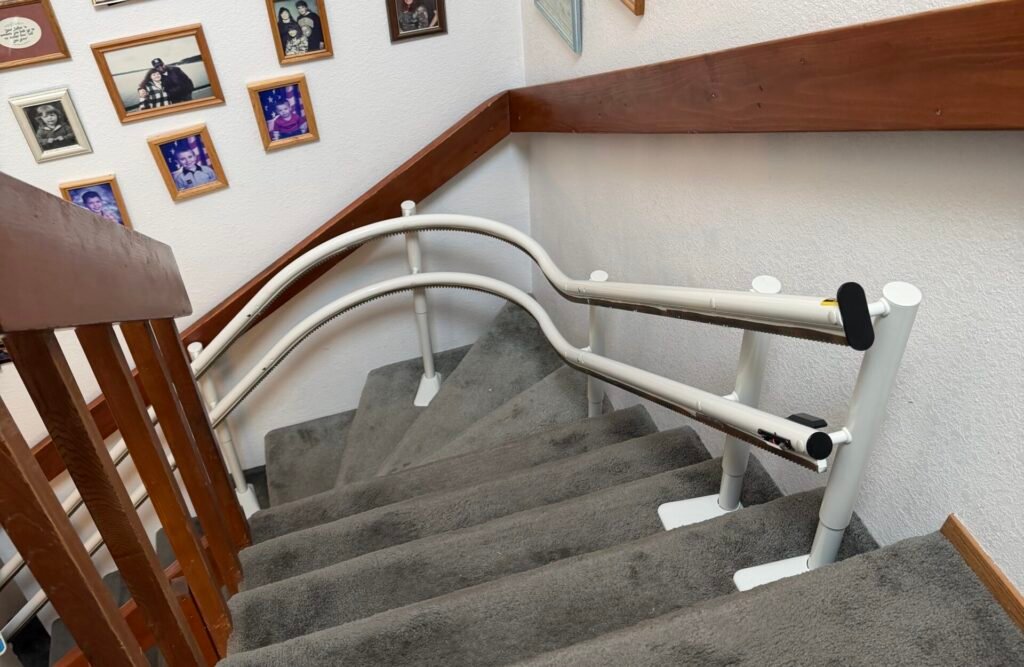
Seattle’s most characterful homes — Capitol Hill Victorians, Queen Anne four-squares, and steep split-levels across the Puget Sound — often share one accessibility challenge: winding, narrow, or multi-landing staircases that a standard straight stairlift simply can’t fit. The solution is a curved stairlift, custom-built to the exact shape of your stairs.
At Seattle Elevator Co., we specialize in curved stairlifts for the region’s older and more complex homes. Here’s what to know.
What Makes a Curved Stairlift Different
A straight stairlift uses a standard, off-the-shelf rail. A curved stairlift requires a custom-fabricated rail engineered to follow your staircase’s exact turns, landings, and angles. That custom rail is what lets a stairlift navigate the spiral and quarter-turn staircases so common in historic Seattle homes — and it’s the main reason curved models cost more and take longer to install.
Why Seattle Homes Often Need Curved Models
- Historic floor plans: Capitol Hill and Queen Anne homes frequently have tight, turning staircases never designed for modern mobility aids.
- Narrow stairways: Older construction tends to have slimmer treads and walls close on both sides.
- Multiple landings: Split-levels and townhomes often break the climb into several short, angled flights.
- Steep pitches: Seattle’s hill-built homes sometimes have steeper-than-average stairs.
Curved Stairlift Cost and Lead Time in Seattle
Because the rail is made to order, curved stairlifts typically run $10,000–$15,000 installed in the Seattle area, depending on the number of turns, landings, and length of the staircase. Straight stairlifts, by comparison, generally fall between $4,500 and $7,500.
Lead time is the other key difference: a curved rail usually requires 2–5 weeks of custom fabrication before installation, whereas many straight models are in stock and can go in within days. The installation itself is still typically completed in a single day once the rail arrives.
Features Worth Prioritizing in the Pacific Northwest
- Powered swivel seat: Makes getting on and off safer at the top landing — especially valuable on tight historic staircases.
- Battery backup: Keeps the lift running during the winter power outages common around Puget Sound.
- Folding rail or hinged track: Helps keep a shared or narrow stairway clear for other household members.
- Compact, foldable design: Seat, arms, and footrest fold up to preserve precious space on slim Seattle stairs.
- Weather-rated components if the staircase is outdoors or in a covered entry.
Is a Curved Stairlift Right for Your Home?
If your staircase turns, has a landing, or is too narrow for a standard rail, a curved model is usually the answer. If you have a simple single-flight staircase, a more affordable straight stairlift will likely serve you just as well — and if stairs aren’t the real obstacle at all, a residential elevator may be a better long-term fit. For model recommendations, see our 2026 buyer’s guide to the best stairlifts for Seattle and Bellevue homes, and for what to expect on install day, read our Seattle stairlift installation guide.
Custom-Fit by Local Experts
Curved staircases demand precise measurement and a custom rail done right the first time. Our veteran-owned Seattle team measures carefully, orders the rail to spec, and installs cleanly with no wall damage — securing the track to the stair treads, not your historic plaster. Explore our stairlift installation service or request a free in-home assessment at (206) 293-3050.
Frequently Asked Questions
How much does a curved stairlift cost in Seattle?
Curved stairlifts typically range from $10,000 to $15,000 installed, depending on the number of turns and landings and the length of your staircase.
Why do curved stairlifts cost more than straight ones?
The rail is custom-fabricated to match your exact staircase, which adds both engineering and manufacturing cost compared to a standard straight rail.
How long does it take to get a curved stairlift installed?
Plan for about 2–5 weeks of custom rail fabrication, followed by installation that’s usually completed in a single day.
Will a stairlift damage my historic staircase?
No. The rail mounts to the stair treads with discreet brackets, not to your walls or handrails, so your home’s original finishes stay intact.
Last updated: June 2026 | Seattle Elevator Co. — Serving Seattle, Bellevue, Kirkland, and the Greater Puget Sound Area