
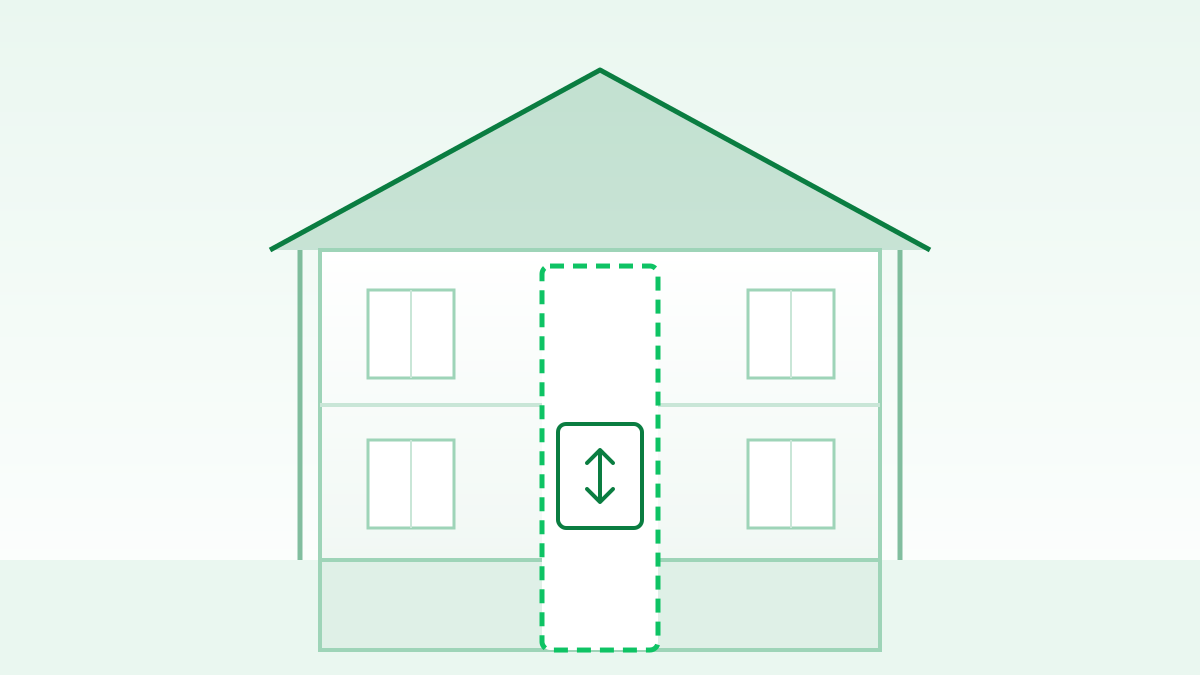
Seattle’s older neighborhoods were built tall and narrow on small lots, with the stairs placed wherever they fit. It makes for houses with real character and, eventually, houses that are hard to live in.
The good news is that Seattle’s older stock is often easier to retrofit than newer construction elsewhere — for one specific reason.
The short version: Seattle homes have basements. A basement gives you somewhere to put the pit and the equipment, which removes the single biggest obstacle that stops elevator retrofits in most of the country.
Why the Basement Matters So Much
In a lot of American markets, homes sit on a slab and there’s nothing underneath. Cutting a pit into a slab is real structural work, and it’s why “no-pit” pneumatic elevators dominate in places like Texas and Arizona.
Seattle is different. Craftsman bungalows, Queen Anne and Capitol Hill four-squares, Ballard and Wallingford boxes — most of them have a full or partial basement, and the excavation problem largely disappears. A conventional hydraulic elevator becomes straightforwardly viable, and the machine space has somewhere sensible to live.
Where the Shaft Actually Goes
This is the question that decides whether a retrofit is reasonable or painful. Four locations come up again and again in older Seattle homes:
- Stacked closets. The prize. Older homes frequently have closets in the same position on each floor, and when they line up, most of the shaft already exists.
- The stair return. Many four-squares have dead space in the turn of the staircase — awkward for furniture, ideal for an elevator.
- Back of the house, off the kitchen. Older Seattle homes often have a rear service stair or a pantry area with more slack than the formal rooms.
- A bump-out. Where nothing inside works, a small exterior addition housing the shaft can be the least destructive answer — though it brings setbacks and the exterior envelope into play.
Shaft construction is the biggest single swing in a retrofit budget, running roughly $15,000–$40,000 depending on how much has to be built. A stacked-closet run sits at the bottom of that; a bump-out sits at the top.
What Older Seattle Homes Throw At You
Balloon framing
Homes built before roughly the 1930s often use balloon framing, where studs run continuously from sill to roof rather than stopping at each floor. It changes how openings are made and how loads are carried, and it needs to be identified before anything is cut.
Plaster and lath
Older walls aren’t drywall. Plaster on wood lath doesn’t patch invisibly, and putting things back to a standard that matches the rest of the house is skilled work — a real part of the $2,000–$8,000 finishing budget rather than an afterthought.
Knob-and-tube and undersized panels
An elevator needs a dedicated circuit and adequate service. Homes still on original panels frequently need capacity added, which lands in the $1,500–$6,000 electrical range — and sometimes more if there’s remaining knob-and-tube in the path.
Floors that aren’t level
A century-old house has settled. Elevators are unforgiving about plumb and level, so the shaft is built true even where the house around it isn’t — which occasionally means visible reveals that need thoughtful trim work.
Permits and Seismic in Seattle
Seattle is one of only two cities in Washington that kept jurisdiction over its own elevator code — Spokane is the other. Everywhere else in the state, the elevator permit comes from Labor & Industries. Inside Seattle, it’s SDCI.
Seismic requirements apply regardless and are not optional. Budget roughly $2,000–$5,000 for permits and seismic compliance. Our Seattle elevator permit guide covers the process in detail, including what inspection involves.
If the house is in a designated historic district or is a landmarked structure, there may be additional design review — particularly for anything that changes the exterior. That’s the strongest argument for keeping the shaft inside the envelope where it’s possible.
What It Costs, Roughly
A straightforward retrofit in an older Seattle home — two stops, an existing closet stack, a basement to work in — generally lands in the standard $35,000–$55,000 range. Add a third stop and you’re adding $8,000–$15,000. Add a new shaft, significant structural work and plaster restoration, and a Queen Anne or Capitol Hill project can move well into the $55,000–$85,000 band or beyond.
Our Seattle cost guide has the full breakdown.
Is It Worth It in an Older Home?
The honest answer is that it depends on why you’re staying. If you love the house and intend to be there for a long time, an elevator is frequently the thing that makes that possible — and in Seattle’s market, a well-executed elevator in a quality older home is generally seen as an asset rather than a medical intervention.
If you’re not sure you’re staying, a stairlift at $4,500–$15,000 solves the immediate problem without touching the structure, and comes out cleanly when you sell. There’s no shame in the smaller solution, and we’ll tell you when we think it’s the right one.
Start With a Walk-Through
Older homes reward looking before quoting. We’ll check the basement, look for a closet stack, assess the framing and the panel, and tell you where an elevator could realistically go — and if the answer is that this particular house makes it difficult, we’ll say that too.
Talk to a local installer
Free, no-pressure consultation across Seattle and the Eastside.
Request a Free EstimateFrequently Asked Questions
Can you put an elevator in a Craftsman bungalow?
Often yes, particularly where the home has a basement and a usable closet stack. Bungalows are smaller than four-squares so space is tighter, but the basement solves the pit problem that blocks retrofits in slab-built markets.
How much does it cost to add an elevator to an older Seattle home?
A straightforward two-stop retrofit with an existing shaft location typically runs $35,000–$55,000. Where a new shaft must be built, add roughly $15,000–$40,000, and plaster restoration and electrical upgrades add further.
Will an elevator damage original features?
It doesn’t have to. The shaft location is chosen partly to avoid original millwork, staircases and finishes wherever possible, and plaster restoration is planned into the scope rather than improvised at the end.
Do I need SDCI approval for an elevator in Seattle?
Yes. Seattle is one of only two Washington cities that retained jurisdiction over elevators, so SDCI is your permitting authority inside city limits, and seismic compliance is required. See our Seattle elevator permit guide.
What if my house is in a historic district?
There may be additional design review, particularly for anything altering the exterior. Keeping the shaft entirely inside the existing envelope usually avoids the most involved review, which is one reason we look hard for an interior location first.
Is a pneumatic elevator better for an older home?
Sometimes. A pneumatic vacuum elevator is self-supporting and needs no pit or machine room, which can be a good answer where the basement is unusable or there’s no room for a conventional shaft. It’s one of the options we assess at the walk-through.
Related: Home Elevator Permit in Seattle · Residential Elevators in Seattle · Home Elevator Cost in Seattle · How Long Installation Takes